
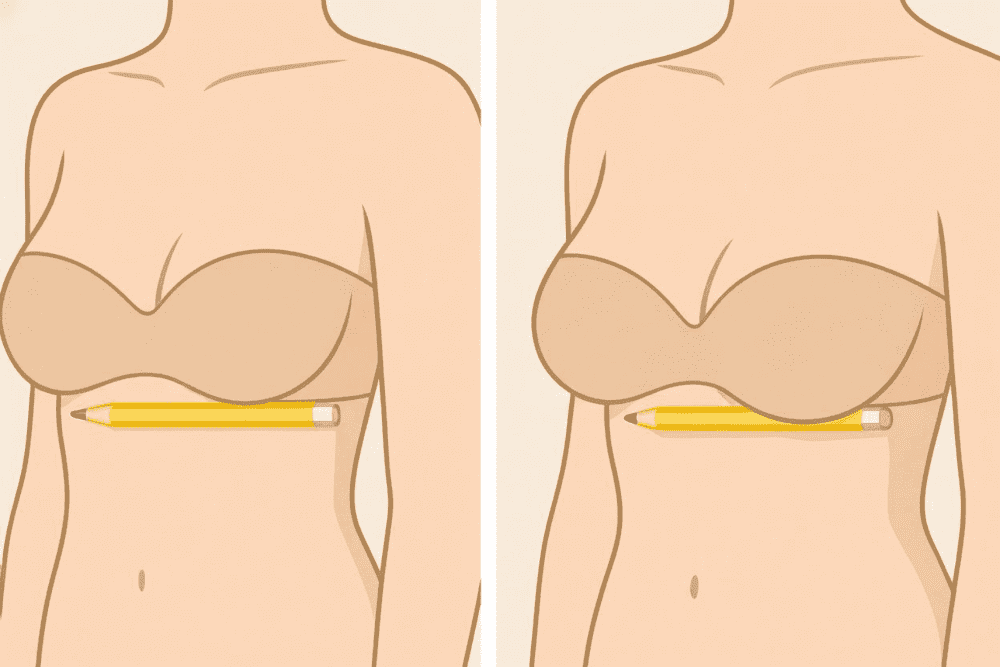
If you’ve ever wondered whether your breasts have started to sag, chances are you’ve heard of the “pencil test.” While this old wives tale has stuck around for decades, how accurate is it really, and what does it actually tell you about whether you might benefit from a breast lift?
Here, board-certified plastic surgeon Dr. Daniel Kolder explains what the pencil test is, what it can and can’t reveal about breast sagging, and what a more accurate evaluation looks like.
What Exactly Is the Pencil Test?
The pencil test is a simple at-home “test” that has been said to determine if your breasts are sagging and, therefore, in need of a breast lift. The idea is to place a pencil (or similar object) under the natural crease of your breast. If it stays in place when you let go, that’s considered a sign of drooping, or ptosis.
While it sounds easy enough, this test doesn’t tell the whole story. Breasts come in all shapes, sizes and skin types, and many women with perfectly normal anatomy could “fail” the pencil test simply because of their natural breast shape or fullness.
Why It’s Not Always a Reliable Measure
Breast sagging (ptosis) depends on several factors, including skin elasticity, breast tissue density, age, genetics and even weight changes or pregnancy. The pencil test doesn’t account for any of that.
For example, a woman with naturally fuller breasts might hold a pencil under her breast crease even if her breasts are still high and perky. Meanwhile, a woman with smaller breasts and mild sagging might not “trap” the pencil at all.
In other words, while the pencil test may be able to give you a general idea of whether or not your breasts are sagging, or track progressive sagging, it can’t replace a professional assessment or help you decide whether or not you’d benefit from a breast lift.
How Plastic Surgeons Evaluate Breast Sagging
During a consultation, Dr. Kolder evaluates breast position based on the location of the nipple in relation to the breast crease. If the nipple sits at or below that crease, it usually indicates some degree of ptosis.
There are also varying levels of sagging, ranging from mild to moderate to significant. Each of these levels may require a slightly different surgical approach. Based on this physical examination, Dr. Kolder can tailor a breast lift, also known as mastopexy, to your specific body shape and personal goals to achieve a smooth, natural-looking result.
When to Consider a Breast Lift
You may want to consider a breast lift if you’ve noticed that your breasts have lost firmness, your nipples point downward or the size, shape or symmetry of your breasts have changed after pregnancy, breastfeeding or weight loss.
A breast lift can reshape and reposition the breasts, tighten stretched skin and raise the nipple to a more youthful-looking position. The result is a firmer, more balanced appearance that still looks completely natural.
If you’re curious about your options for breast lift surgery in California, Dr. Kolder and his team at Pacifica Plastic Surgery can provide a personalized evaluation and help you understand what’s best for your body.
To schedule your personal consultation, give us a call at 805-484-2855 or contact us online.

Author: Dr. Daniel G. Kolder
Dr. Daniel G. Kolder is board certified by the American Board of Plastic Surgery. As a highly trained plastic surgeon serving Ventura County, he is best-known for his warm, easy manner, compassionate care, and beautiful, natural results.